
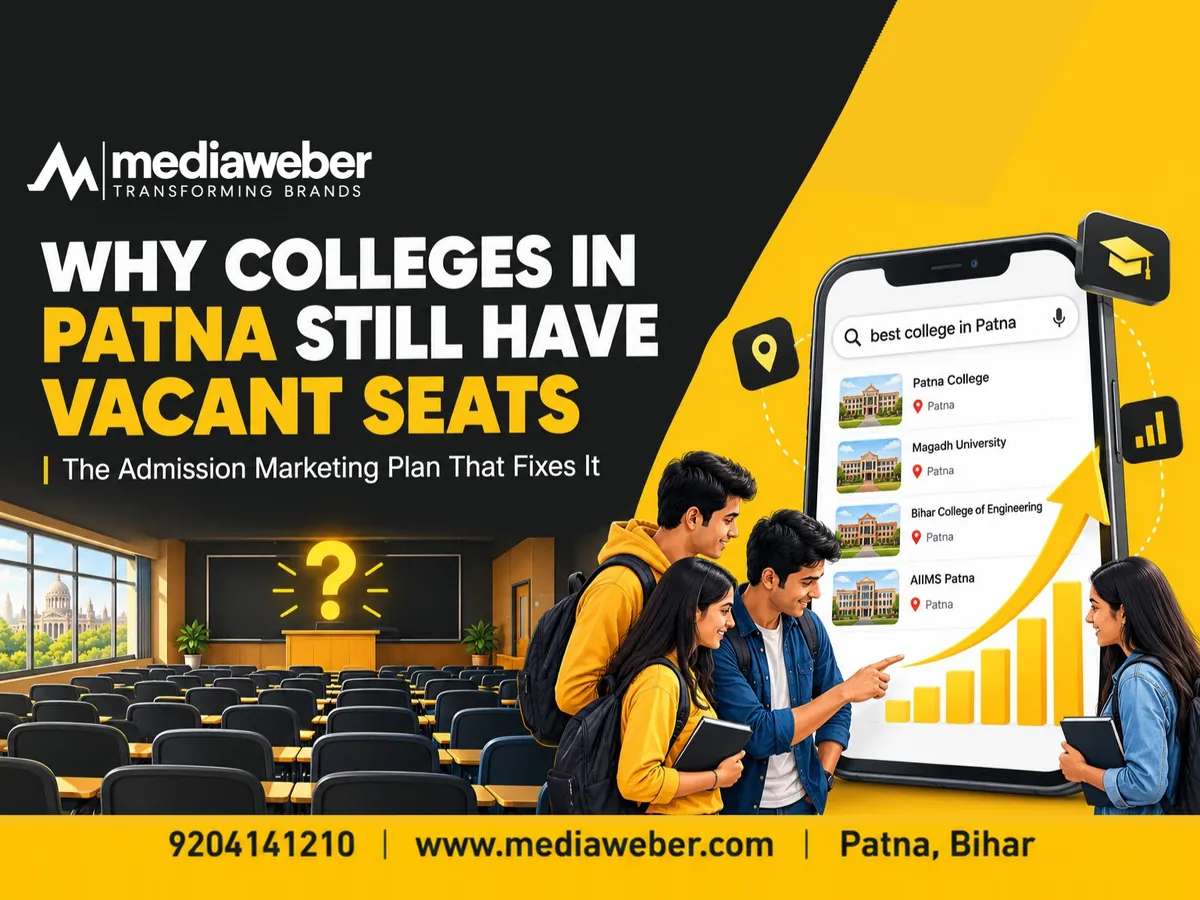
Every admission season in Bihar, the same quiet story repeats. A college has an experienced faculty, a solid campus, and decent results. The brochure is printed, the hoardings are up, the counsellors are ready. Yet when the last date passes, a few dozen seats are still empty.
If that sounds familiar, the problem is rarely the quality of your institution. It is the distance between your college and the student who is deciding, usually on a phone, usually at night, usually with a parent watching over their shoulder.
At Mediaweber, a digital marketing agency in Patna, we look at college admission marketing as a system, not a one-month advertising push. In this guide, we break down why seats stay vacant and what a modern admission campaign should look like for colleges in Patna and across Bihar.
Why Do Good Colleges in Bihar Still Have Vacant Seats?
Students today do not choose a college from a single newspaper ad. They compare. They search, scroll through reels, read reviews, ask seniors, and then inquire at three to five institutions at once. A college loses seats when it is weak at any step of that journey. In our experience, four gaps cause most of the damage.
- Students Cannot Find Your College Online
Open Google and Instagram and search the way a student would: “best college in Patna for BBA” or “MBA colleges in Bihar”. If your college does not appear in the results, in the maps listing, or in a single useful reel, you are invisible at the exact moment of decision.
Visibility is built through three basics:
- A Google Business Profile with current photos, courses, and reviews
- Course pages on your website that answer fees, eligibility, and placements clearly
- Regular social media presence in the places students actually spend time
Google’s own SEO Starter Guide is a good reference for the fundamentals your website team should already be following.
- Nobody Is Telling Your College’s Story
“Admissions Open” is the most repeated phrase in education advertising. When every college says it, no college stands out. Students and parents respond to proof: a real student describing a normal day, a faculty member explaining a concept in 30 seconds, an alumnus talking about the first job, a campus tour that shows what the place actually feels like.
Story-led content builds trust before a student ever fills a form. It also gives your social channels something worth saving and sharing, which helps reach. If you want a content approach built around this idea, see our social media marketing services.
- Inquiries Come In, but Admissions Do Not
This is the most expensive gap, because the college has already paid to get the inquiry. Common leaks include:
- Calls returned the next day, after the student has spoken to a competitor
- One generic message sent to every inquiry, regardless of course
- No record of which ad, post, or reel produced which lead
- No follow-up after the first conversation
A simple rule helps: respond to every inquiry within minutes, and follow up at least three times over two weeks. Combine that with a tracking sheet or CRM, and you can finally see your real cost per admission instead of guessing.
- The Campaign Starts Too Late
Many colleges begin promotions only when the admission window is already open. By then, students have shortlisted options. Colleges that start awareness work in October and November, well before counselling and application deadlines, enter that shortlist early and are far more likely to convert by June.
What a Modern College Admission Campaign Looks Like
A good admission campaign works in four connected stages, and each one has a clear job.
Stage 1: Awareness (October to December)
Goal: become a name students and parents recognise. Use campus reels, faculty introductions, student stories, and short explainer videos. Run local awareness ads targeted by location, age group, and interests across Patna and nearby Bihar districts.
Stage 2: Lead Generation (December to March)
Goal: collect inquiries from interested students. Send ad traffic to dedicated landing pages for each course, not your homepage. A landing page should have one clear promise, key course details, trust proof, and a short form. Our landing page and lead generation services are designed around exactly this.
Stage 3: Counselling and Nurture (March to May)
Goal: move inquiries towards applications. Use quick calls, WhatsApp follow-ups, campus visit invitations, and scholarship or fee information. Parents are often the real decision makers here, so create content aimed at them too.
Stage 4: Conversion and Retargeting (May to June)
Goal: close the remaining seats. Retarget people who visited your site or watched your videos, remind applicants about deadlines, and share fresh admission updates.
Measure What Matters
A campaign you cannot measure cannot be improved. Track these numbers monthly:
- Cost per inquiry and cost per admission
- Inquiry-to-application and application-to-admission rates
- Top performing ad, reel, and landing page
- Response time of your admission team
When you know which channel produces admissions rather than just inquiries, you can move budget towards what works and cut what does not.
A Quick Self-Check for College Owners and Directors
Answer these honestly:
- If a student searches for your course in Patna today, do you appear?
- Does your social media show real students, or only posters?
- Can your team tell you the source of every lead this month?
- Is your admission campaign planned for the full season, or only the last few weeks?
If two or more answers are “no”, your seats are probably leaking somewhere between awareness and admission.
Frequently Asked Questions
How can a college increase admissions in Patna?
Combine local search visibility, story-led social media content, dedicated landing pages for each course, fast lead follow-up, and an early campaign start. Together these reach students at every stage of their decision.
When should a college start its admission marketing campaign?
As early as October or November for the next academic session. Early awareness work gets your college into the student’s shortlist before application deadlines create competition.
Is social media enough for college admissions?
No. Social media builds awareness and trust, but admissions also depend on search visibility, a conversion-focused website, and disciplined follow-up with every inquiry.
How much should a college spend on admission marketing?
It depends on seat targets, course fees, and competition. A better question is your acceptable cost per admission. Tracking this number lets you set a budget based on results instead of habit.
Do you work with colleges outside Patna?
Yes. Mediaweber supports colleges and educational institutions across Bihar and other parts of India.
Fill Seats Before Next Season Starts
Vacant seats are not a quality problem. They are a visibility, storytelling, and follow-up problem, and all three can be fixed with a planned campaign.
If you want to know where your college is losing students, Mediaweber offers a free admission funnel audit for colleges in Patna and Bihar. Visit www.mediaweber.com or call 9204141210 to book your strategy call.